

Intensive Iteration - KF Legends #002
Changes incoming to the newly released Legend cards!
Hello there, everyone!
I hope you’re all good. KF Legends is better than ever thanks to it just starting its 1.1 version!
Iterating is Cool
While working on the next KF Legends set, me and some close friends are also playtesting the first one (and having fun doing so!). This playtesting has shown that the format roots are solid, deckbuilding is fun with the right amount of guidance coming from the chosen Legends and many Legend card designs feel exactly as intended: a mix of what their houses do in Call of the Archons.
Playing the format also solved something pointed by a comment in the original Reddit release that was also in the back of my mind. Was locking the keys behind the Legends a mistake? Could it lead to longer games? More importantly, was it making the format better?
Our games gave us the answer: that mechanic may be the most interesting thing about the format. It is definitely the main guide for your deckbuilding, helping you choose house pods (those which do what fulfills the “Genesis:” abilities on your Legends cards) and ensuring your deck is not just an arrangement of your best pods. Well-built decks do not encounter any problems to free their keys at a reasonable pace. But the cool thing about it is that it also creates interesting in-game dynamics! I’ll talk in depth about the format dynamics at some other point, by now you can just be sure that locking the keys works amazingly.
Iterating is Cruel
However, playtesting also did what it is supposed to do: make design flaws apparent. Some Legend cards are just in need of a numerical adjustment because I did not realise how easy or difficult it would be to achieve certain board states. Other flaws hid major problems that could be exploited to break games. Everything needs fixing, which fortunately we can do after release because of not being an official product and not charging anyone for anything.
Because of this, there is a new Changelog page on the KF Legends document. The intent for it is to reflect every change in Legend cards (or the How To Play page, but I reeeally hope that will not be necessary) along time, allowing everyone to go back to the original iteration of the cards if they are interested in doing so. Updates will be releasing the 1st of the month, hopefully not every month but just when deemed necessary. Every update will be followed by a newsletter issue devoted to them, covering the changes in depth and giving explaining the reasoning behind them. So if I gutted your favourite card, you’ll be able to understand why. That’s something, right?
Welcome to 1.1
Every update with no new set released will add 0.1 to the current version of the project. These are the 9 cards (43% of the set) that have changed in version 1.1:
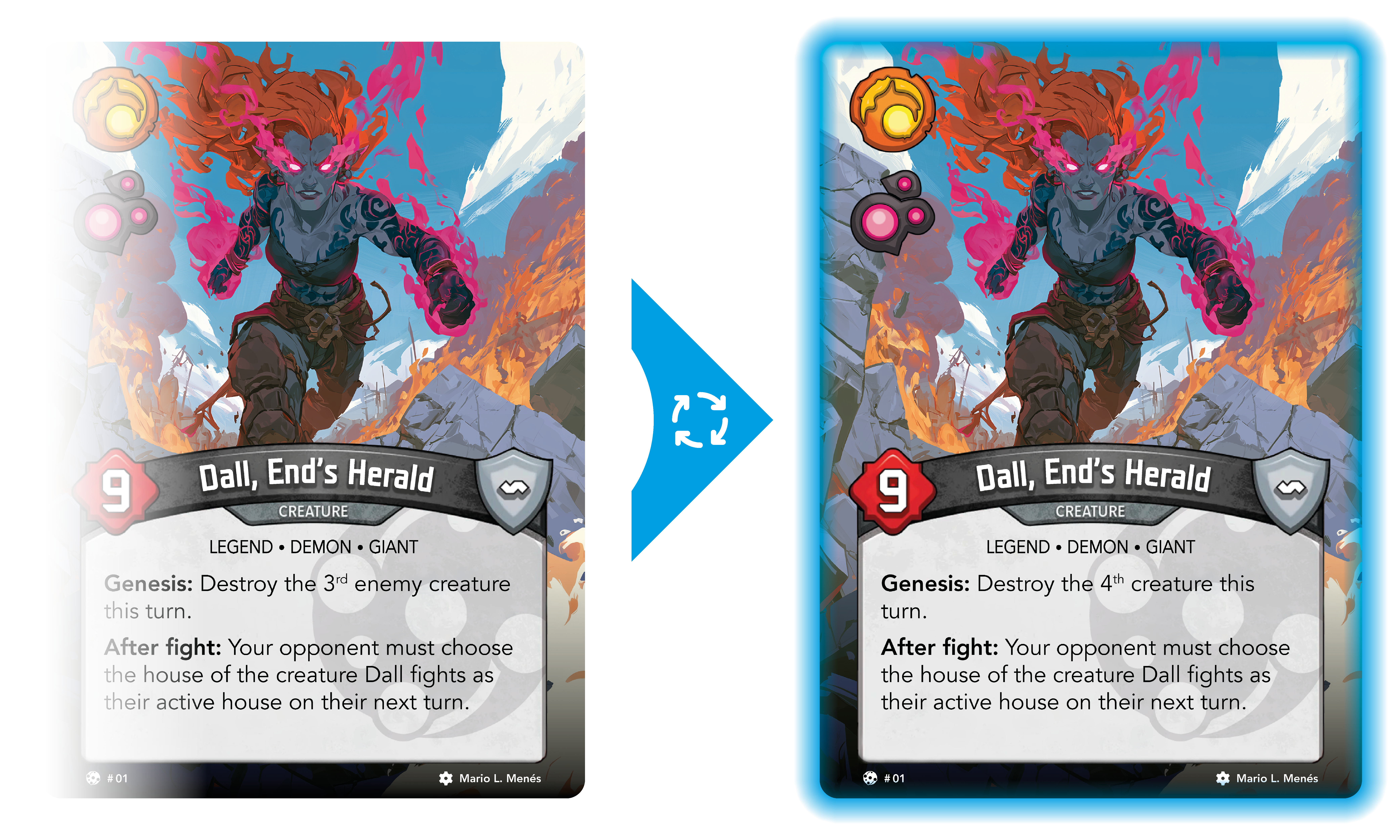
Dall, End’s Herald (CotL #01) had a major flaw hidden in its original design. It allowed your opponent to lock you out of victory by simply never playing more than 2 creatures, making it impossible for you to trigger her “Genesis:” ability and release the key her Legend card was locking. This is absolutely not acceptable in the design: it should always be feasible for you to maneuver into a position from where to fulfill “Genesis:” abilities.
Her new design feels more Dis-like, being able to sacrifice your own creatures for a greater good. It is probably slightly easier to fulfill, lining up with just two combats between equally-powered creatures. We may nerf 1 power away from Dall in a future update if she performs too well in future playtestings, which is quite a big impact for a creature that needs to repeteadly survive combats to trigger its cool effect more than once.
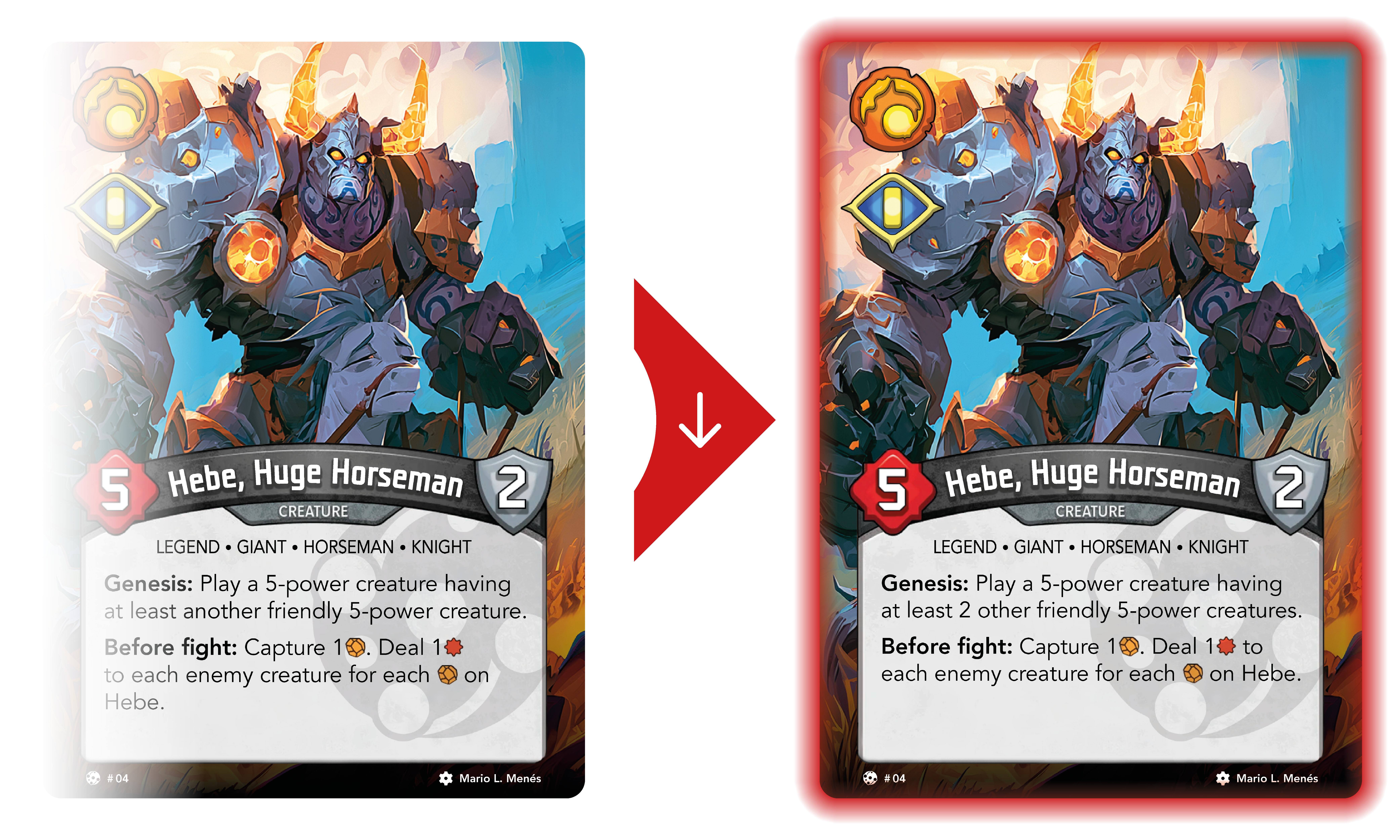
Hebe, Huge Horseman’s (CotL #04) “Genesis:” ability was just too easy to fulfill. Decks built around the card will still be able to play it out consistently, which is cool because its “Before fight:” ability feels very in-house (for both of its houses) and is not overwhelming while being impacful. Combat-based Legend cards have an inbuilt restriction as they usually have to take damage to activate their effects, limiting the time they stay in play. And it works!
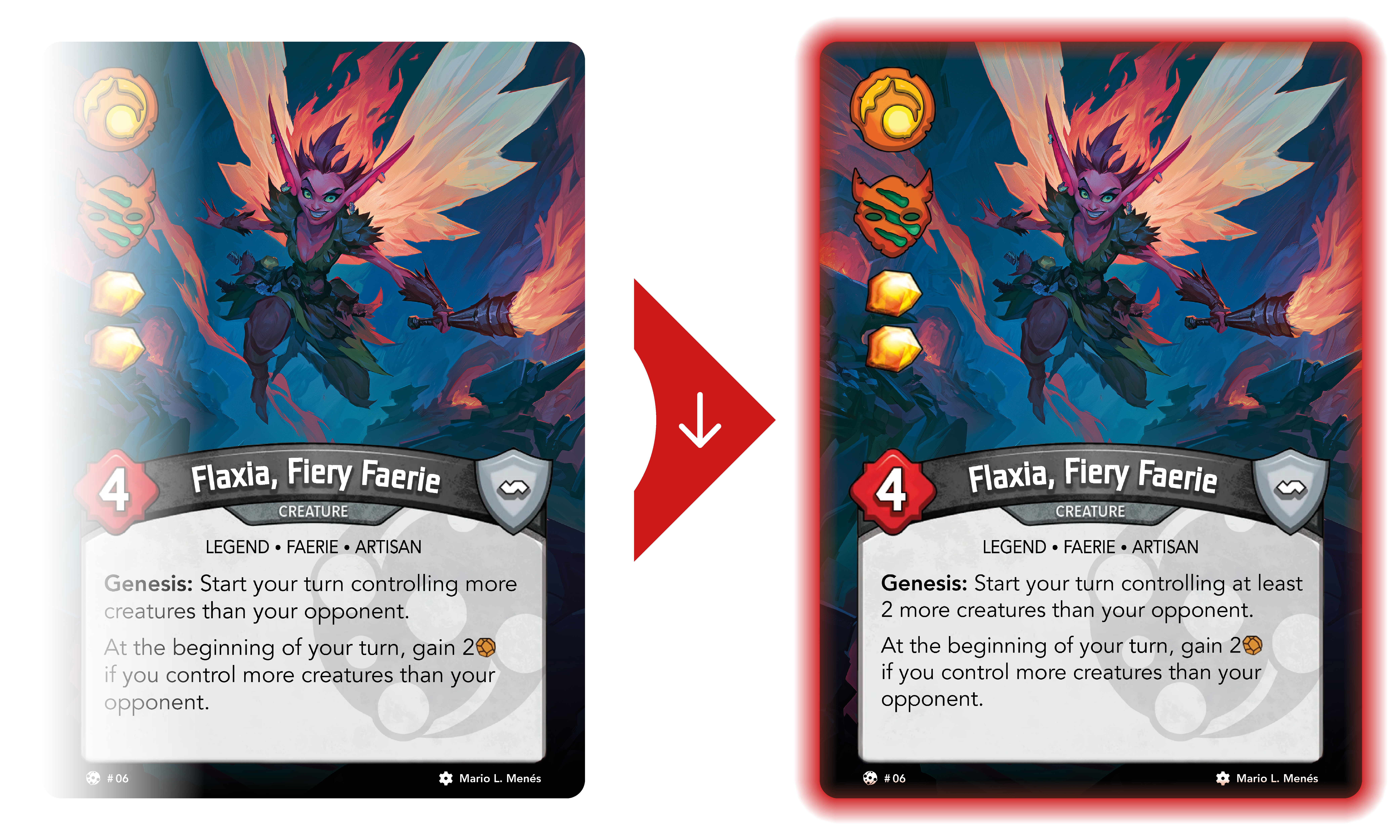
Flaxia, Fiery Faerie’s (CotL #06) “Genesis:” ability was also too easy to fulfill for a Legend card generating 2 Æmber when played. It definitely has to retain its Æmber pips to keep its design fantasy (and be in line with the KeyForge cards it references, which I will talk about in some other newsletter), so making it more difficult to play is the way to go. I still suspect she may go into your hand too easily, so it wound not be surprising if she goes through a similar nerf again in the future. But I like her having a “2” theme, so let’s try out this!
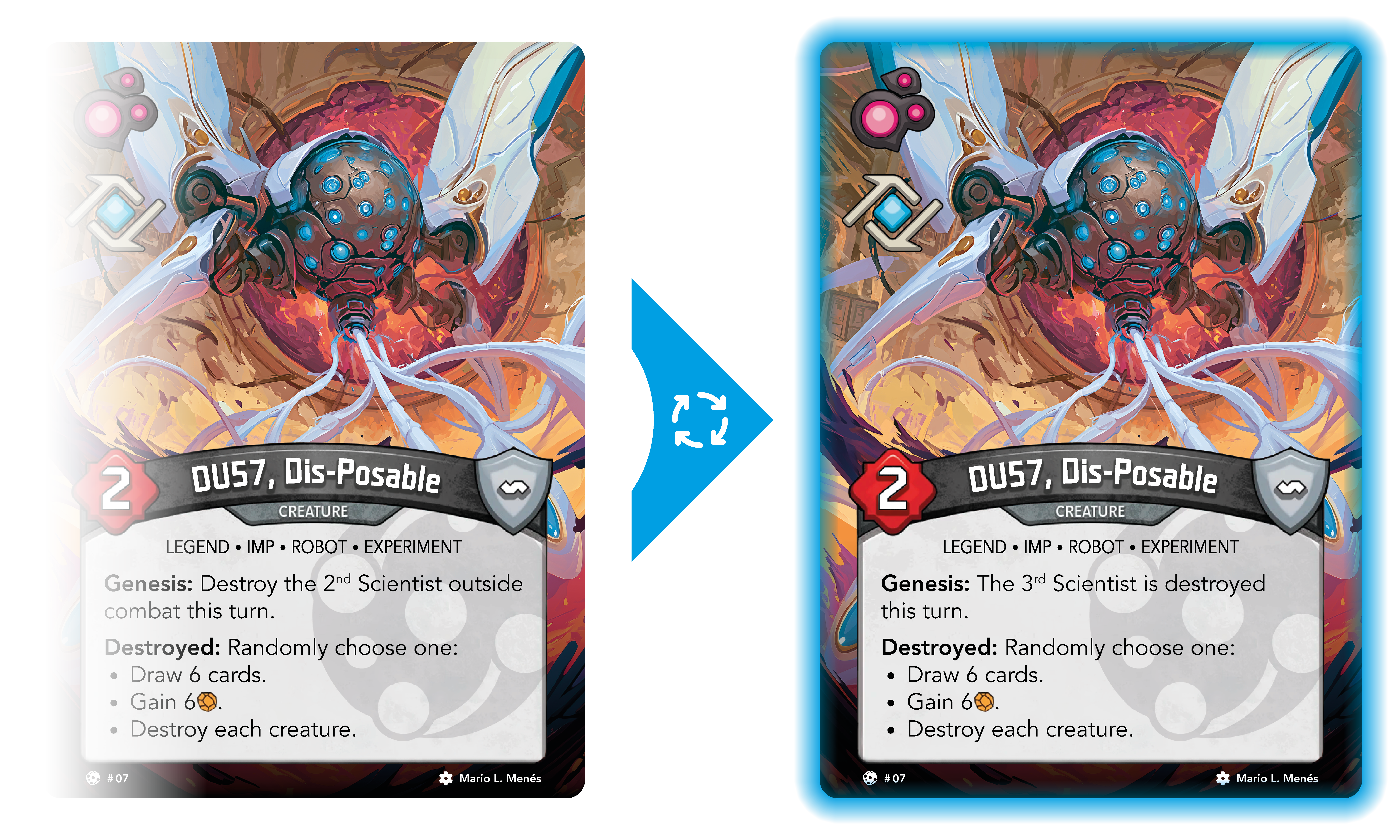
DU57, Dis-Posable (CotL #07) was VERY hard to play, specially more than once. It asked for a lot of steps: play at least 2 Scientists and also a removal card targeting your own stuff in the same turn, or your opponent may have the chance to remove those Scientists so they will not be there to be destroyed by your other house removal. As having your keys locked with little ways to free them is not fun, we chose to heavily simplify the conditions.
Now DU57 asks you to play a bunch of Scientists in your deck: it still offers your opponent a big amount of counterplay as they can remove them from the board, but it can now trigger during your opponent’s turn if they do remove 3 of them. You can also now just fight with them if they survived, saving your removal for your opponent’s creatures (but I would still recommend running a removal-heavy Logos pod, as it will allow you to kill the ones played in that same turn). It is still not a piece of cake to get out, but the effects are very powerful even if random so it probably should not be. We feel like it is closer to its right spot now, and while it is not a direct buff, the card will definitely be a ton more playable like this.
DU57’s playtesting also confirmed us that randomness is fun! And that will impact a card a bit later on in this list.
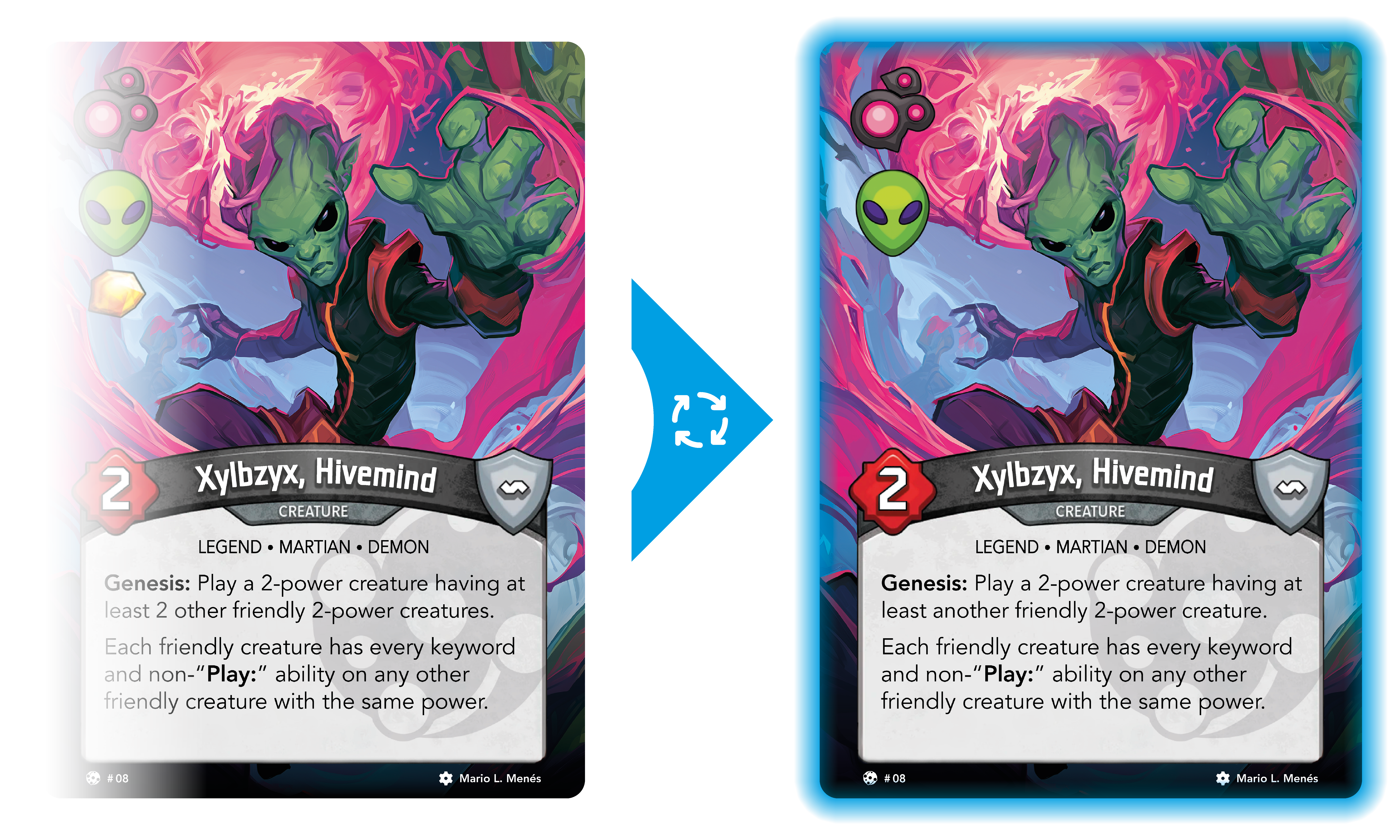
Xylbzyx, Hivemind (CotL #08) really receives a buff, because its “Genesis:” ability was also very difficult to achieve almost requiring you to have three 2-power creatures of the same house to play together. These creature are so fragile that your opponent is usually able to remove your 2 power creatures every turn. It is now way easier to get into your hand, but losing that immediate 1-Æmber impact we feel it will not be problematic even if hitting the table multiple times. Its effect depends on small creatures remaining in play, so while you could definitely cook around it the impact it has can be heavily counterplayed.
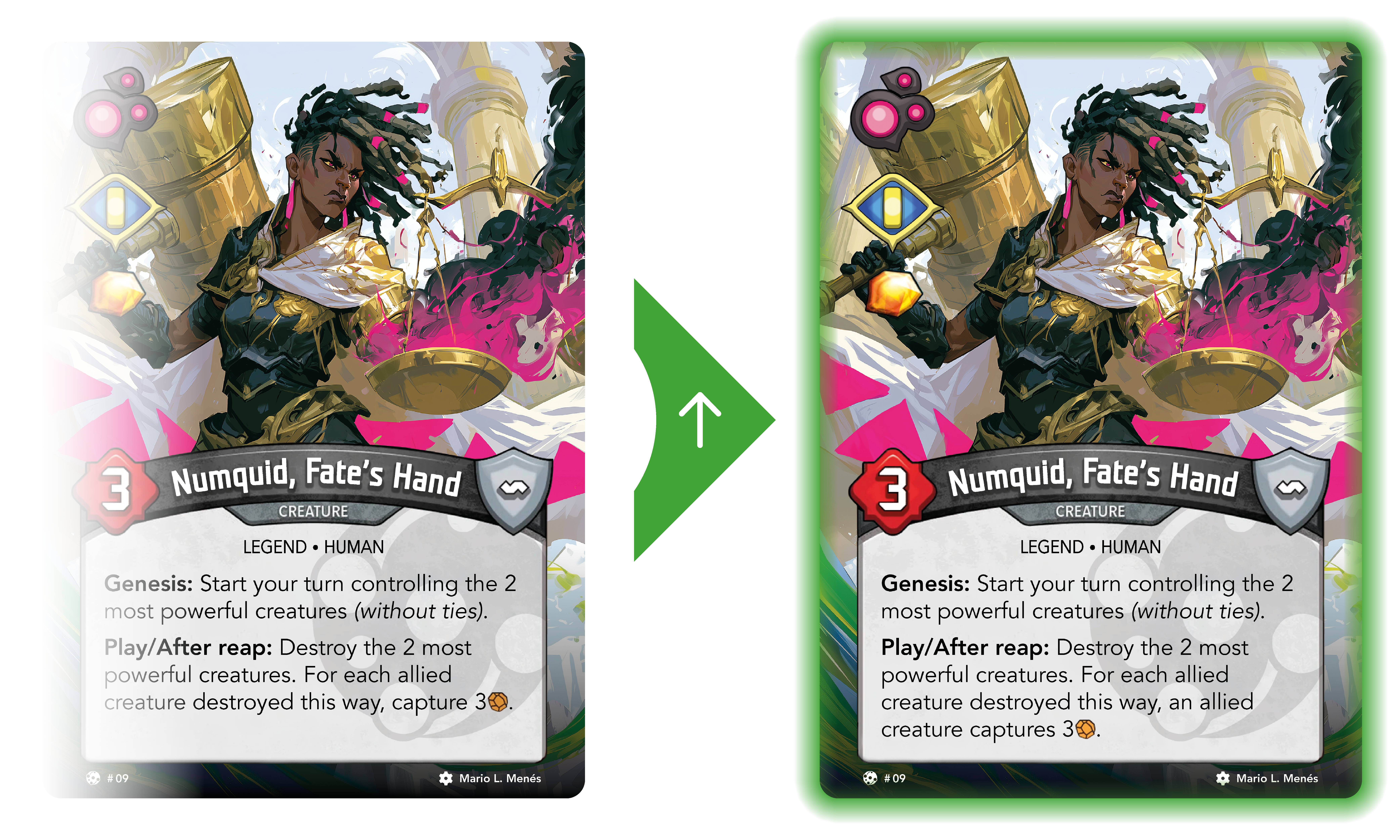
Straight buff for Numquid, Fate’s Hand (CotL #09), allowing its “Play/After reap:” effect to capture the Æmber on allied creatures other than herself. By design, this is a clunky Legend to play with, but it does an spectacular work when things line up her way (and, as my friend Diego “Crimson” discovered and exploited, when paired with a certain demon!). As she is asking for powerful creatures, letting her capitalize on them (if she can avoid killing them) seems like a very logical move that mitigates part of its clunkiness.
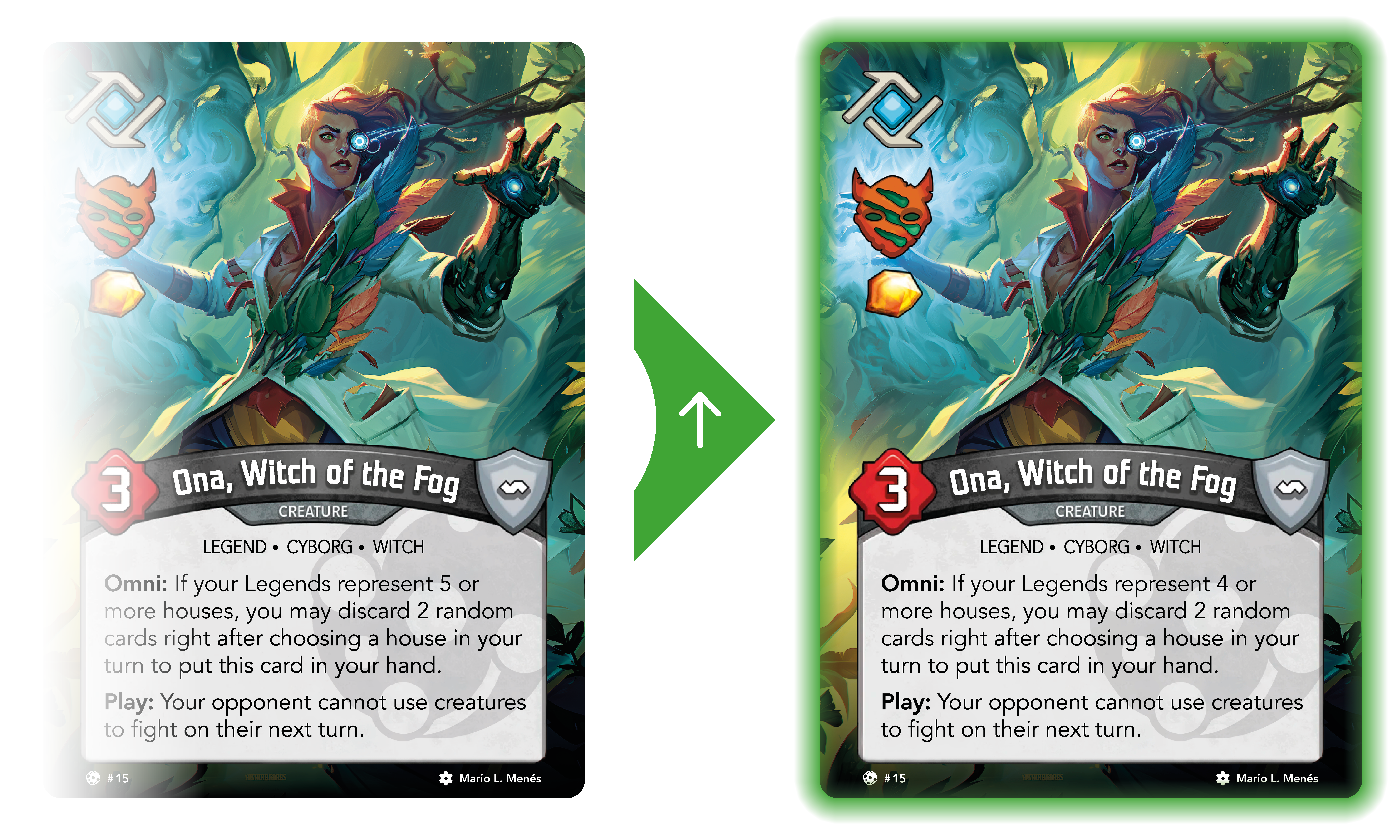
Playtesting showed to what degree is it worse to build a deck with 4+ houses instead of just playing the old 3-house staple. You get punished in many different ways because KeyForge mechanics are conceived to work with that number at so many levels. As I do wanna explore the design space the format offers for building weird decks, we are buffing Ona, Witch of the Fog (CotL #15) to work with just 4-house decks. Payoffs for running a 5-house deck will need to be WAY stronger than this to offset the innate disadvantage.
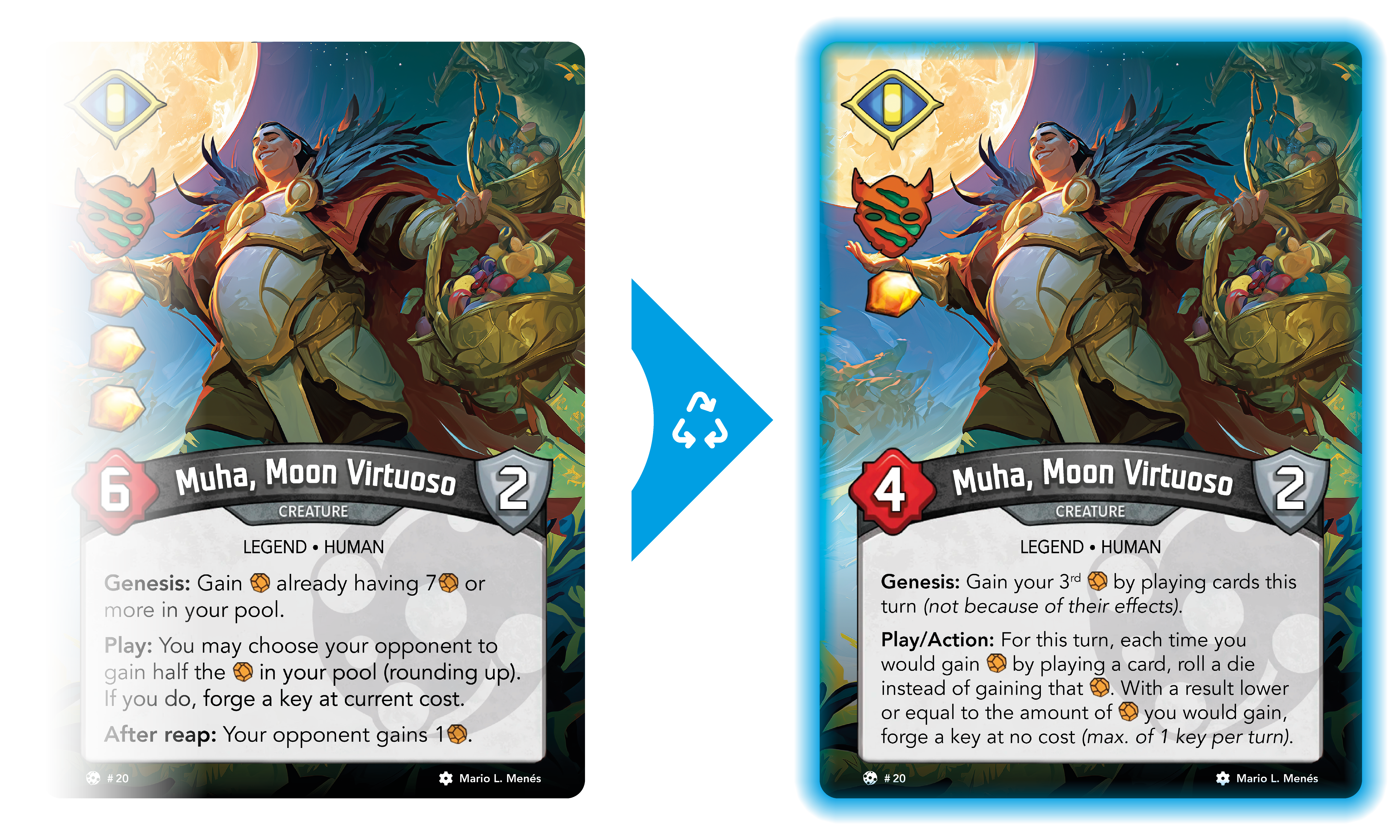
Muha, Moon Virtuoso (CotL #20) was just a failed design which I will talk about more within some other newsletter. It teaches a lot about why designs fail. As a result, the card was very weird to work around and potentially incredibly exploitable: a time bomb ticking until some player broke it, but also a strange Legend that many players did not know how to build.
It has been completely reworked into something that incorporates the lesson DU57 gave us: random effects are cool! It now allows players to spend their Æmber as lottery tickets, with a substantial prize if winning but absolutely nothing won at the end of the turn if lost… which should happen more often. I feel this design is 100% clearer on what it brings to your table and still rewards the exact same rush house pods that I was trying to encourage with the first monstrosity of a design. Fulfill the “Genesis:” ability with a Virtuous Works (or Fertility Chant if you are feeling fancy) and go on playing Full Moons, Hunting Witches, Fuzzy Gruens and other Æmber-heavy friends!
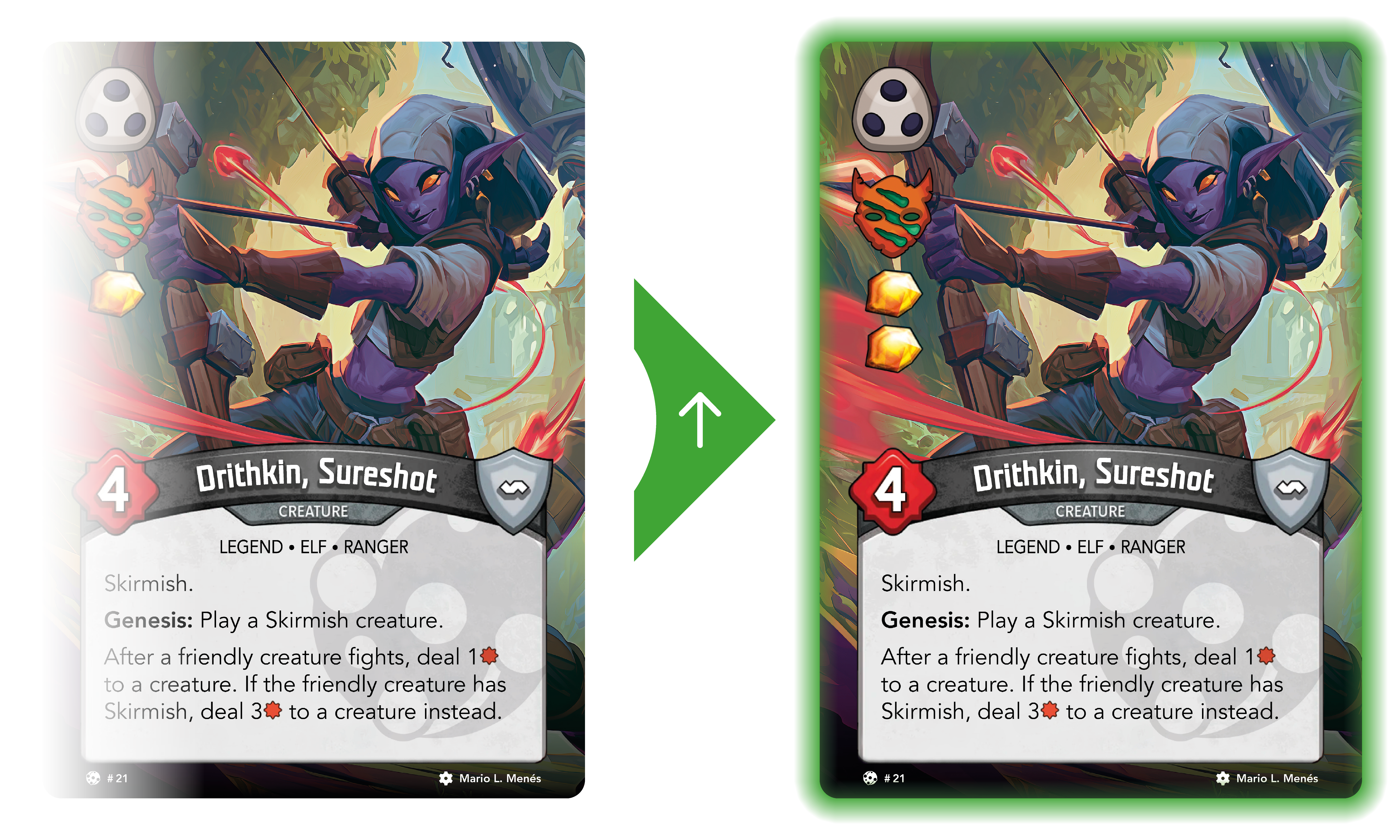
And a simple one to end it: Skirmish creatures are… kinda meh, and Drithkin, Sureshot’s (CotL #21) ability is not the strongest either. Both its houses have good Æmber generation so it feels appropiate to reward you that way for building around such a mediocre keyword.
That’s it for this week! See you next Monday!
¡Fue una gran experiencia jugar con el diseño original! Es interesante ser partícipe de un proyecto en sus fases iniciales, cuando empieza a apreciarse qué funciona bien y qué necesita ser ajustado.
Respecto a lo primero, el hecho de que las llaves estén bloqueadas desde el inicio es el mayor acierto. Además de ser una parte fundamental del formato, evita caer en la construcción típica de alianzas, con esos pods competitivos que a menudo se alejan de la esencia misma del juego original. En mi caso, para las primeras partidas, elegí pods de Brobnar de barajas que tenía completamente abandonadas en el fondo de un cajón, pero que combinaban muy bien con los Legends elegidos. Pensé en una baraja de 72 cartas en la que tendría recursos que ni siquiera llegaría a tener en la mano antes de que terminara la partida. En este sentido, me pareció más lógico plantear una partida con un tablero sólido, con criaturas resistentes y, a la vez, una cantidad considerable de limpiamesas para contrarrestar un tablero rival igualmente adecuado para sus propios objetivos. En definitiva, mi objetivo fue utilizar más las cartas en la mesa y materializar combinaciones para desbloquear los Legends que plantear una carrera de aembar sin sentido.
En cuanto a los ajustes, como no podía ser de otra manera, el juego real, más allá del PDF, muestra muchas de las necesidades de balance que al principio pueden pasar desapercibidas. El diseño de las nuevas versiones seguramente dará lugar a más ajustes para alcanzar un mejor equilibrio, primero entre Legends del mismo set y, después, con los nuevos Legends que aparezcan. Es un camino largo, que será divertido recorrer y que habrá que completar con paciencia y muchas más partidas.
It was a great experience to play with the original design! It is interesting to take part in a project during its early stages, when it starts to become clear what works well and what needs to be adjusted.
As for what works, the fact that keys are locked from the start is the strongest design choice. Besides being a fundamental part of the format, it prevents the game from falling into the typical alliance-building structure, with those competitive pods that often move away from the very essence of the original game. In my case, for the first few games, I chose Brobnar pods from decks that I had completely abandoned at the bottom of a drawer, but that combined very well with the chosen Legends. I was thinking about a 72-card deck in which I would have resources that I might not even get into my hand before the game ended. In that sense, it seemed more logical to approach the game with a solid board, resilient creatures and, at the same time, a considerable number of board wipes to counter an opponent’s board that would also be well suited to their own objectives. Ultimately, my goal was to make greater use of the cards on the board and set up combinations to unlock the Legends, rather than turn the game into a meaningless æmber race.
As for the adjustments, as was to be expected, real gameplay, beyond the PDF, reveals many balancing needs that can easily be overlooked at first. The design of the new versions will probably lead to further adjustments in order to reach a better balance, first among Legends from the same set and then with the new Legends that appear later. It is a long road, one that will be fun to follow and that will have to be completed through patience and repeated games.